
8 Steps to Get Your Practice Recommended by ChatGPT
One practice got three new patients from ChatGPT in about three weeks, after writing a few pages on a topic nobody else in their area had covered. All three booked. ChatGPT reads the websites in your area, learns from the most complete one and recommends that practice. Here are the eight steps to make it yours.
Rather see how this works for your own practice? Watch the short breakdown →
Three new patients in about three weeks. That’s what one practice got from ChatGPT after writing a few pages on a topic nobody else in their local area had covered. All three booked.
Right now, someone in your town is telling ChatGPT exactly what’s wrong with them, and ChatGPT is about to tell them which practice to go to.
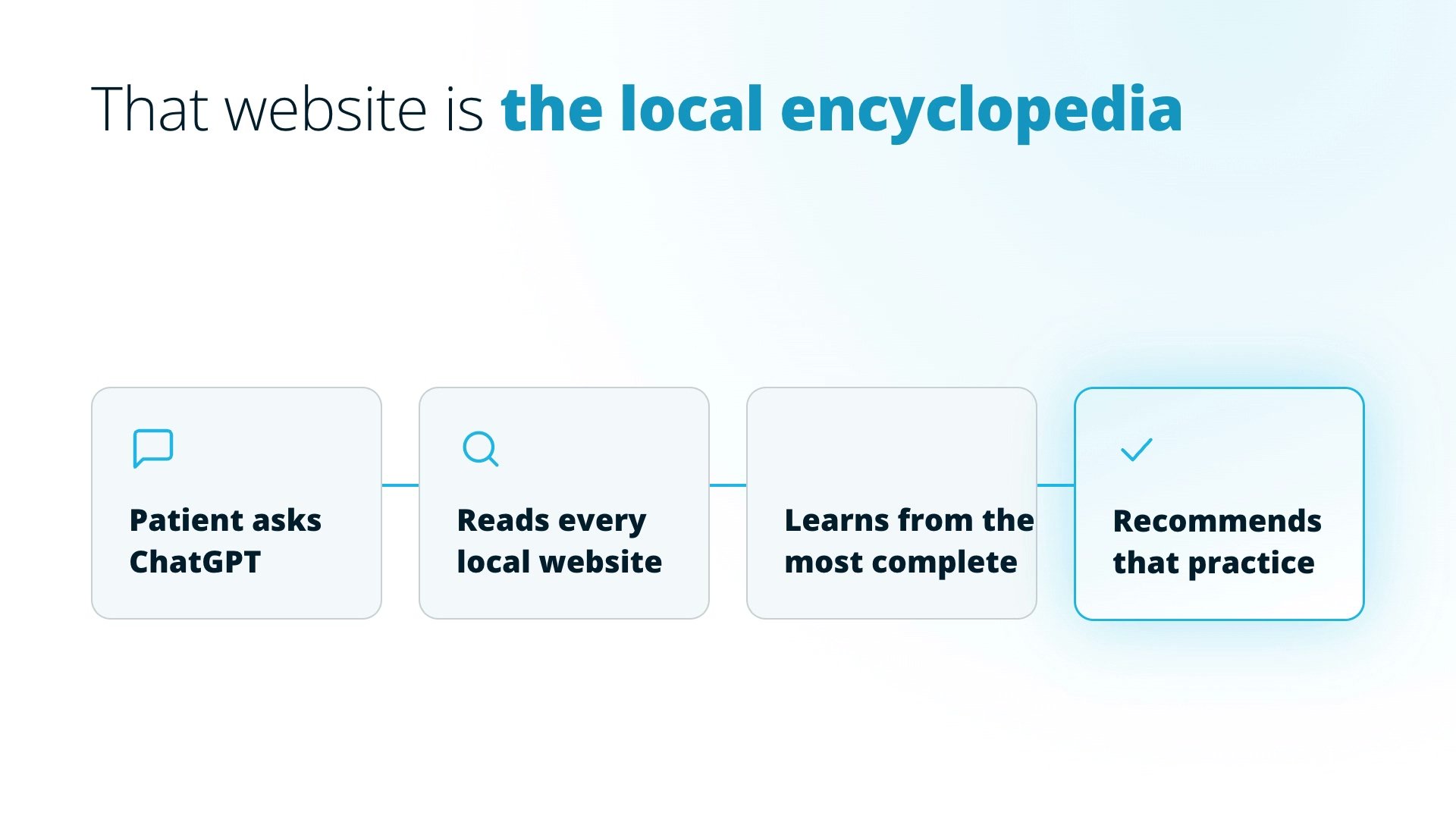
Most practice owners have no idea how it decides. It decides by doing research. When ChatGPT and Google need to find out what’s available locally for a service, they read the websites in your area. They learn from the most complete one, and then they recommend the practice they learned from.
That website is the local encyclopedia, and it should be yours.
I’ll use a chiropractor as the example, but it works the same if you’re a dentist, a physiotherapist, a psychologist or a podiatrist.
Step 1: The full story question
Most practice owners think patients still find them the old way. Type “chiropractor” and the town into Google, then scroll through ten links.
That’s changing fast. People type their whole story into ChatGPT now:
“I get headaches most afternoons, and my neck is always tight. I work on a laptop all day. Could a chiropractor help me? Who’s good near me?”
Where it hurts, what they do all day, what they’ve already tried. Then they ask who can fix it.
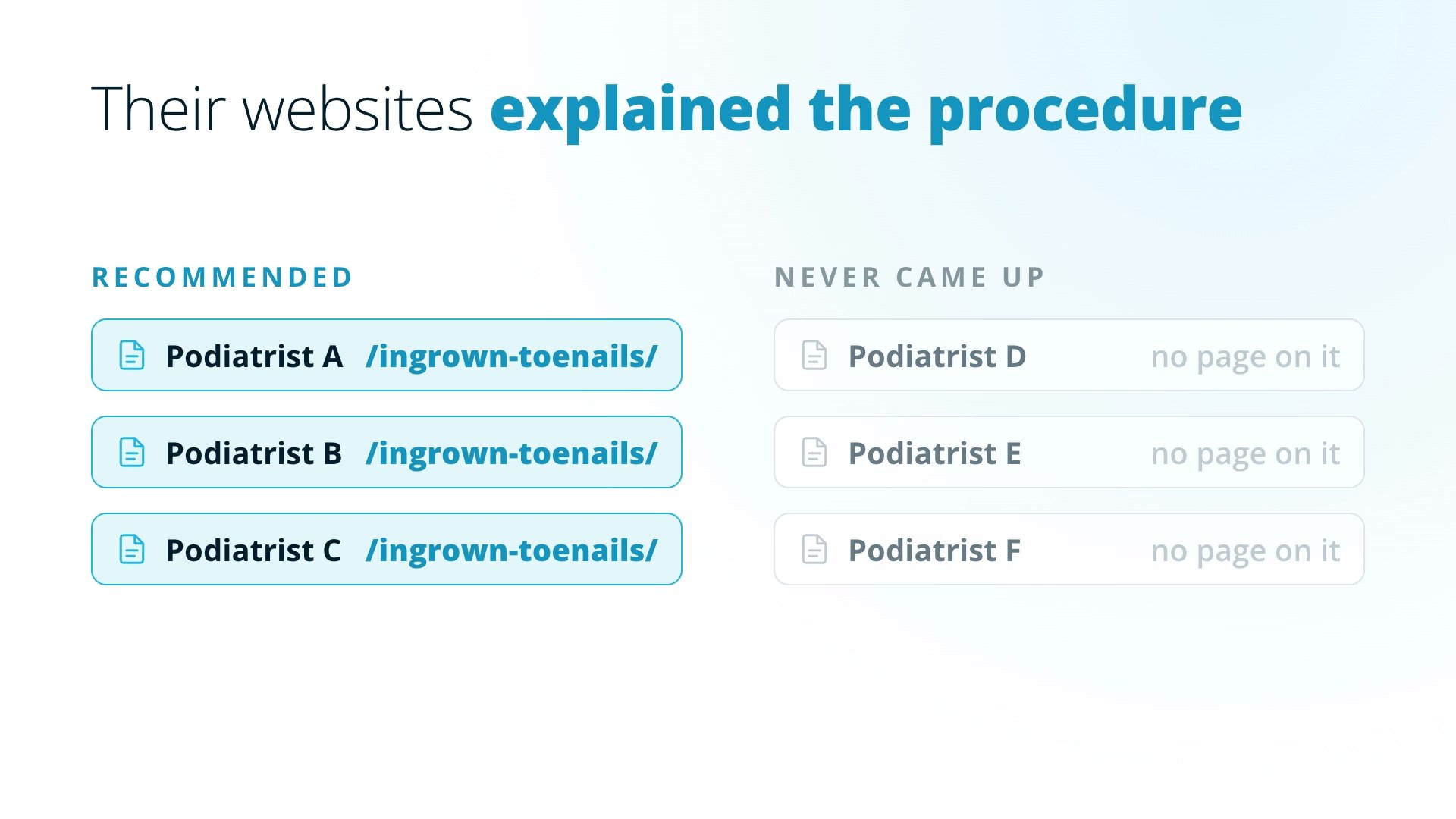
I did this myself. One of my kids had an ingrown toenail, and I knew there was a very specific procedure to remove it properly. I’d forgotten what it was called, so I couldn’t even Google it. I described it to ChatGPT the way I remembered it. It worked out the name, explained how it works and found three people in my area who did it. I rang all three, compared availability and cost, and we were booked within ten minutes.
I never looked at a list of search results. Those three podiatrists got recommended because their websites explained that procedure. The ones whose websites didn’t never came up.
Step 2: The local encyclopedia
An encyclopedia has all the information in it. It’s the one place you go to find out everything you need to know about something.
That’s what ChatGPT and Google are looking for. When someone asks about a service in their area, they want one website with the complete answer. If they find it, they lean on it. They use your pages to teach the patient what the problem is, how it’s treated and what happens at the first visit, and at the end of the answer they say: “This is who you should go to.”
If nobody has the complete answer, they piece one together from bits of different sites, and nobody stands out.
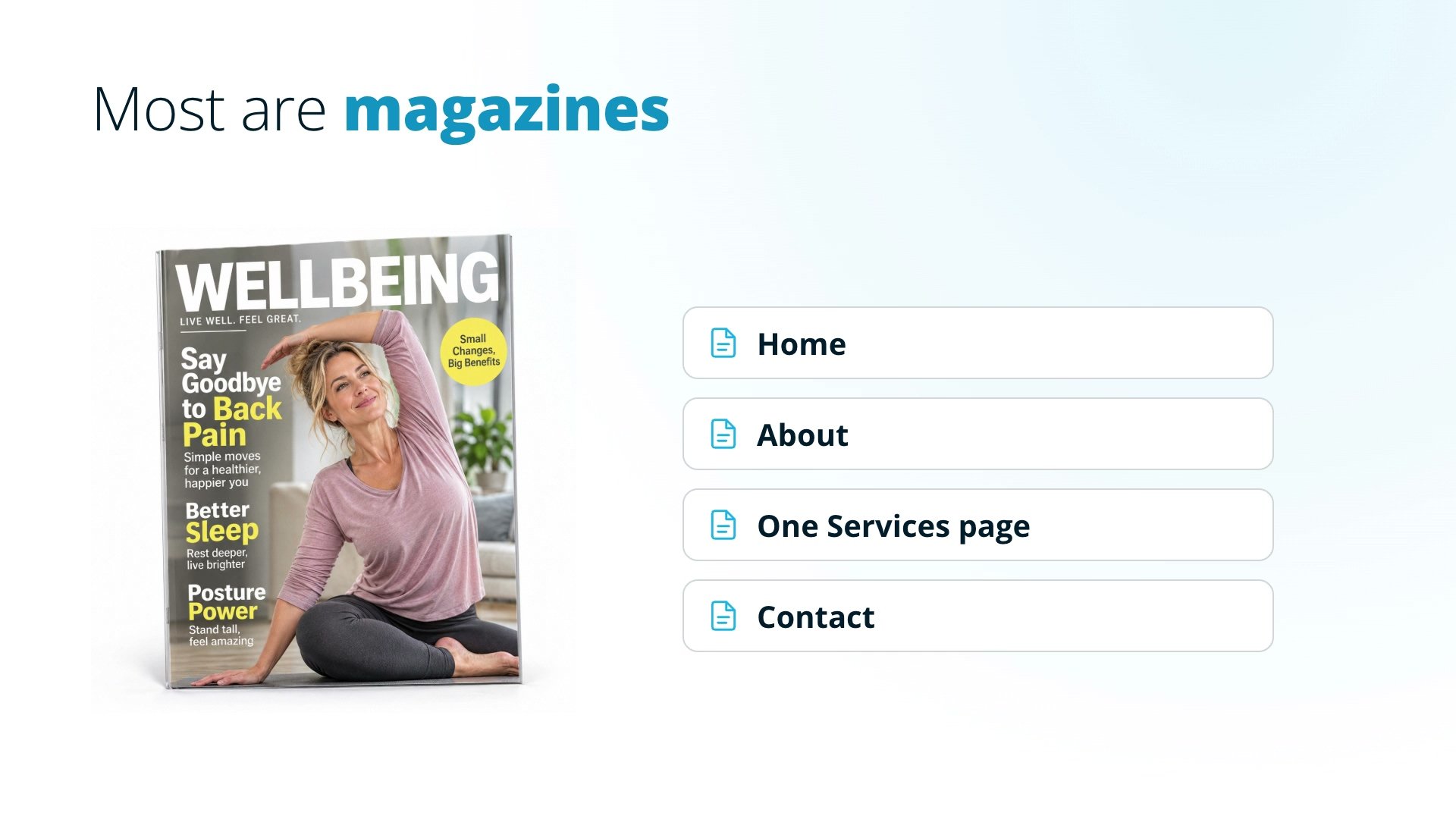
Now look at your competitors’ websites. Most of them are magazines. A little bit of this, a little bit of that. A homepage, an About page, one Services page for everything, and a Contact page.
Your website becomes the encyclopedia: the most complete answer on your service in your local area. Every service, every condition, every kind of patient, every location, every practitioner, every price.
Last week I spoke with a practice owner who’s up against a group with 45 clinics and around 900 pages on their website. He thought he had no chance. But those 900 pages are spread across the whole country, and about his local area they barely say anything. Done properly, he’s the encyclopedia there, and they’re the magazine.
Step 3: The six-page answer
So what goes in the encyclopedia? Take this question:
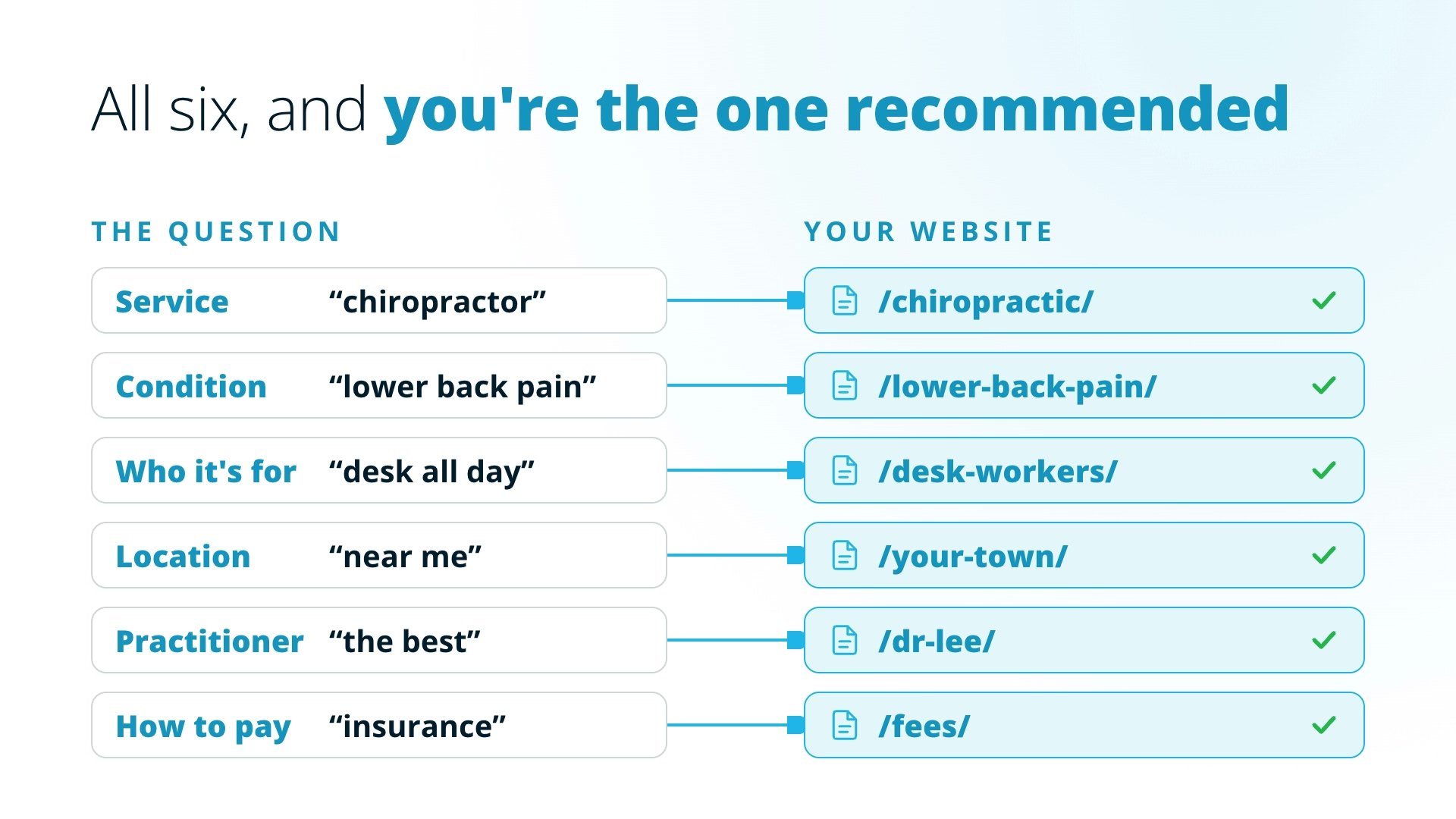
“Who’s the best chiropractor near me for my lower back pain? I sit at a desk all day. Will my insurance cover it?”
Google and ChatGPT break that into parts and look for a page on your website that answers each one:
- The service: chiropractor. Is there a page on chiropractic care?
- The condition: lower back pain. Is there a page on lower back pain on its own?
- Who it’s for: “I sit at a desk all day.” Is there a page for desk workers with back pain?
- The location: near me. Is there a page about your town and the people you look after there?
- The practitioner: who’s the best? Is there a page on the person they’d see, with their training and what they focus on?
- How to pay: will my insurance cover it? Is there a page on fees, insurance and what the first visit costs?
Have all six and you’re the most complete answer in your area. Your content gets used in the answer, and you’re the practice that gets recommended.
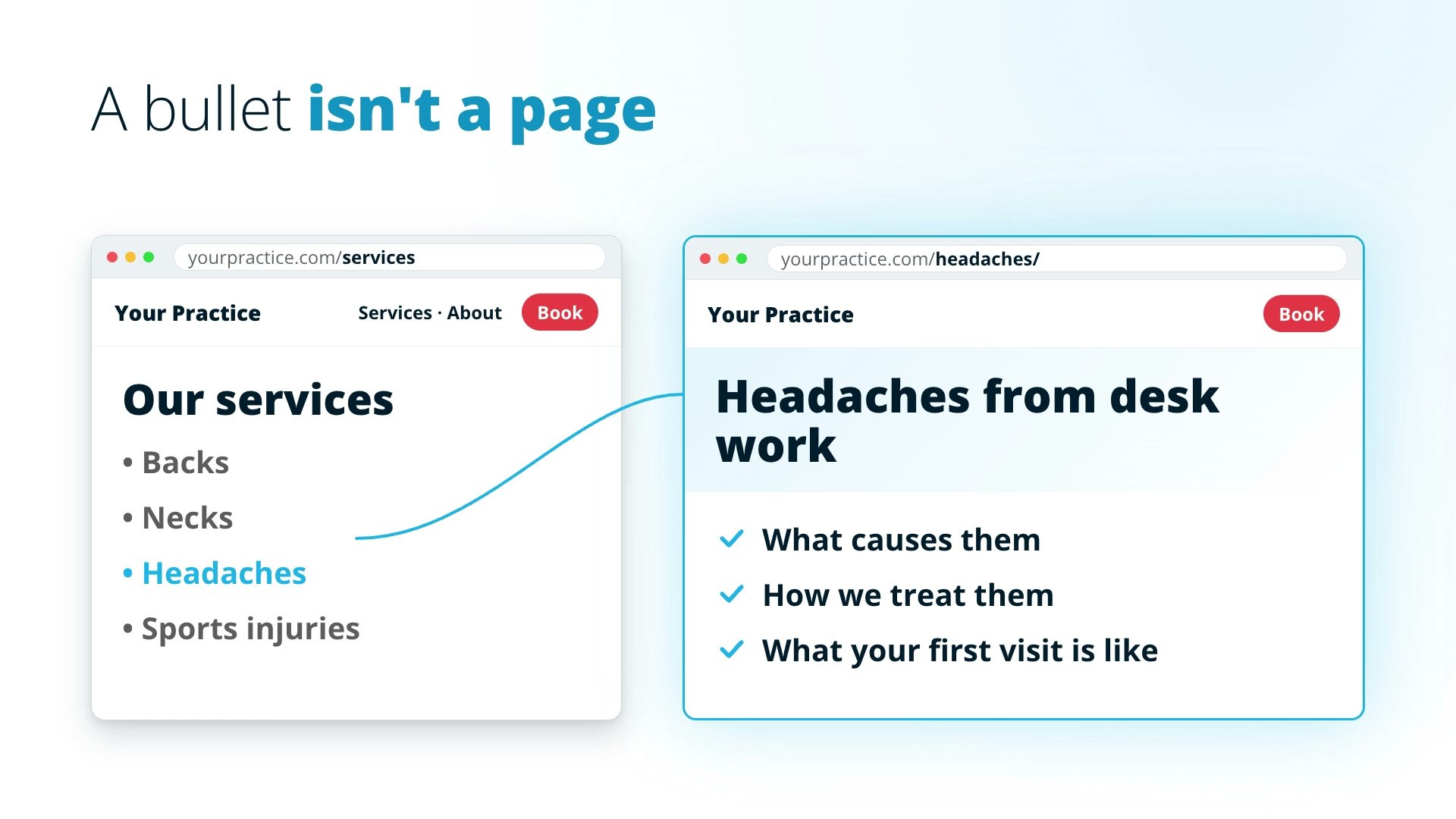
Most practices have one Services page with a bulleted list: backs, necks, headaches, sports injuries. Google has to dig through that one page to work out what you actually do, and whether you even understand it. A page on just headaches from desk work, explaining how you treat them, shows you know your stuff. (I go deeper on this in why Google shows your competitor and not you.)
Ask yourself that question about your own practice. Then go through the six and write down which pages you actually have.
Step 4: The fifteen-practice rule
When practice owners hear “every service, every condition, every kind of patient”, a lot of them panic. They say to me, “Marlon, I can’t outwrite WebMD.”
You don’t have to. You need to be the encyclopedia for your local area, and that’s it. Your competitors are ten or fifteen practices, not thousands. Most of them have thin websites, so the bar is low.
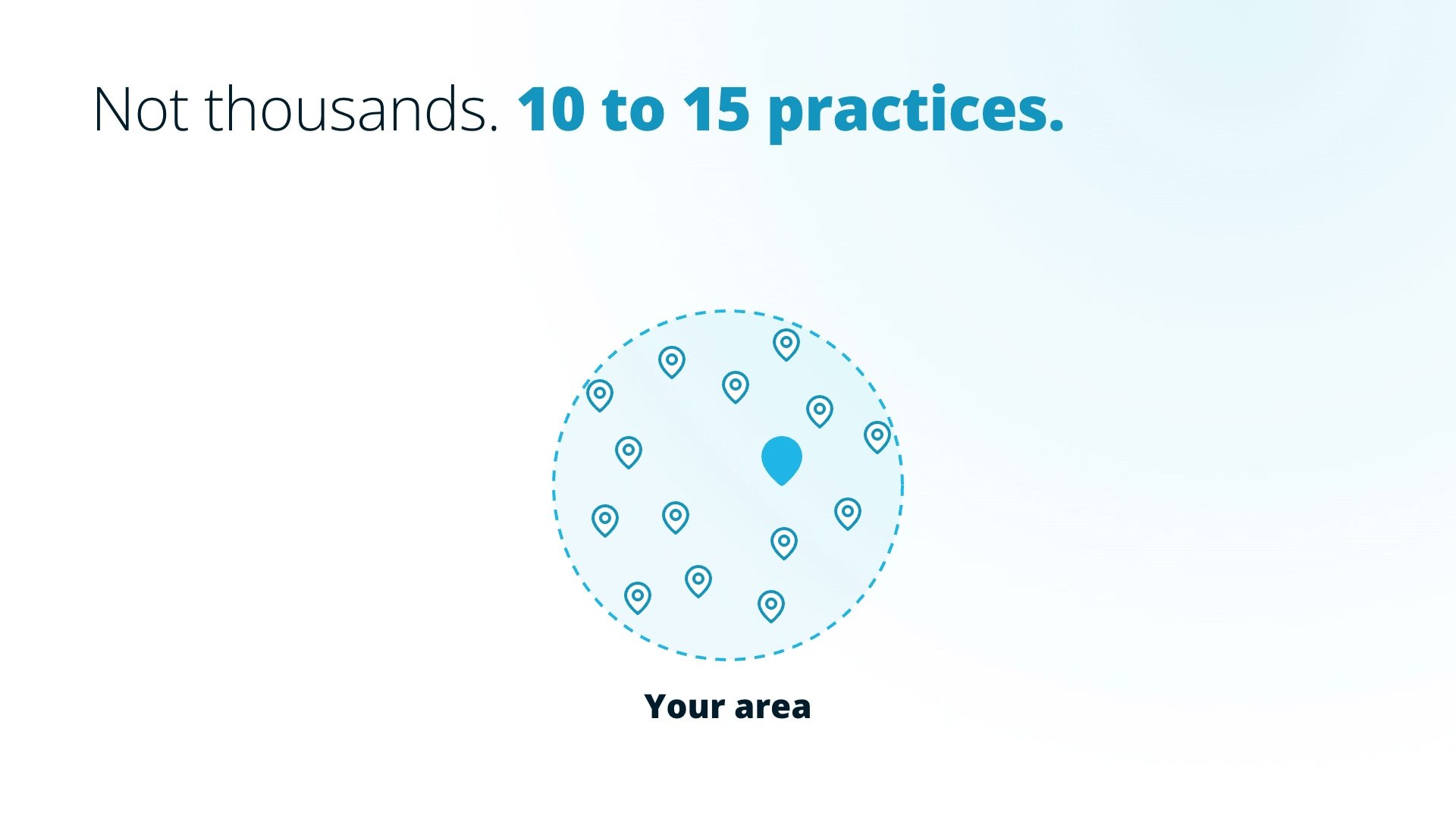
The practice that becomes the encyclopedia first holds the spot.
Step 5: Top by default
I hear this on almost every call: “Marlon, I asked ChatGPT, and it already recommends me.”
So I ask how many pages are on their website. “About ten.”
If ChatGPT is recommending you off ten pages, it’s struggling to find information. Everyone around you is just as thin, so you’re on top by default.
One chiropractor worked it out while I was still talking: “So I’m only number one because nobody else has done it, and when somebody does, I’m gone?”
He’s right. When one of those ten or fifteen practices builds the encyclopedia, it takes your spot. Give ChatGPT what it’s looking for first and you keep it.
Step 6: The early mover window
If you’d started doing SEO properly twenty years ago and kept at it, nobody could touch you today. With ChatGPT, you’re at that point right now. The very beginning.
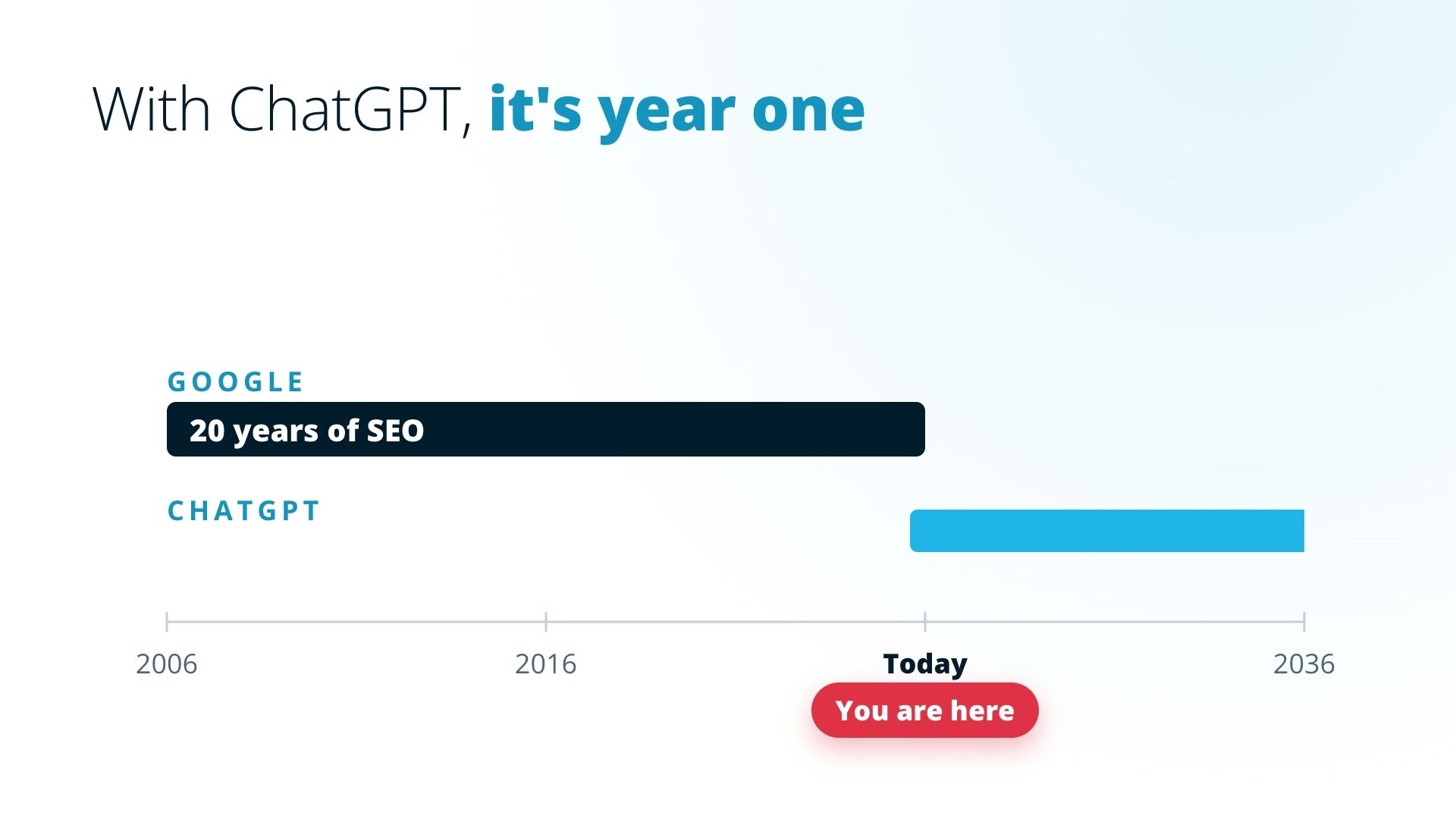
Once ChatGPT trusts a source, it keeps going back to it, and it’s very hard for someone else to come in over the top. The practice that becomes the encyclopedia in your area now can hold that spot for the next ten years. The one that waits ends up fighting for it.
Step 7: The one in three patient
A lot of people tell me their website traffic is dropping because of ChatGPT. They’re right. ChatGPT sends fewer people to websites than Google used to.
Look at the people it does send, though. Our clients tell us that when someone comes from Google Ads, about one in ten books. When someone comes from ChatGPT, it’s about one in three.
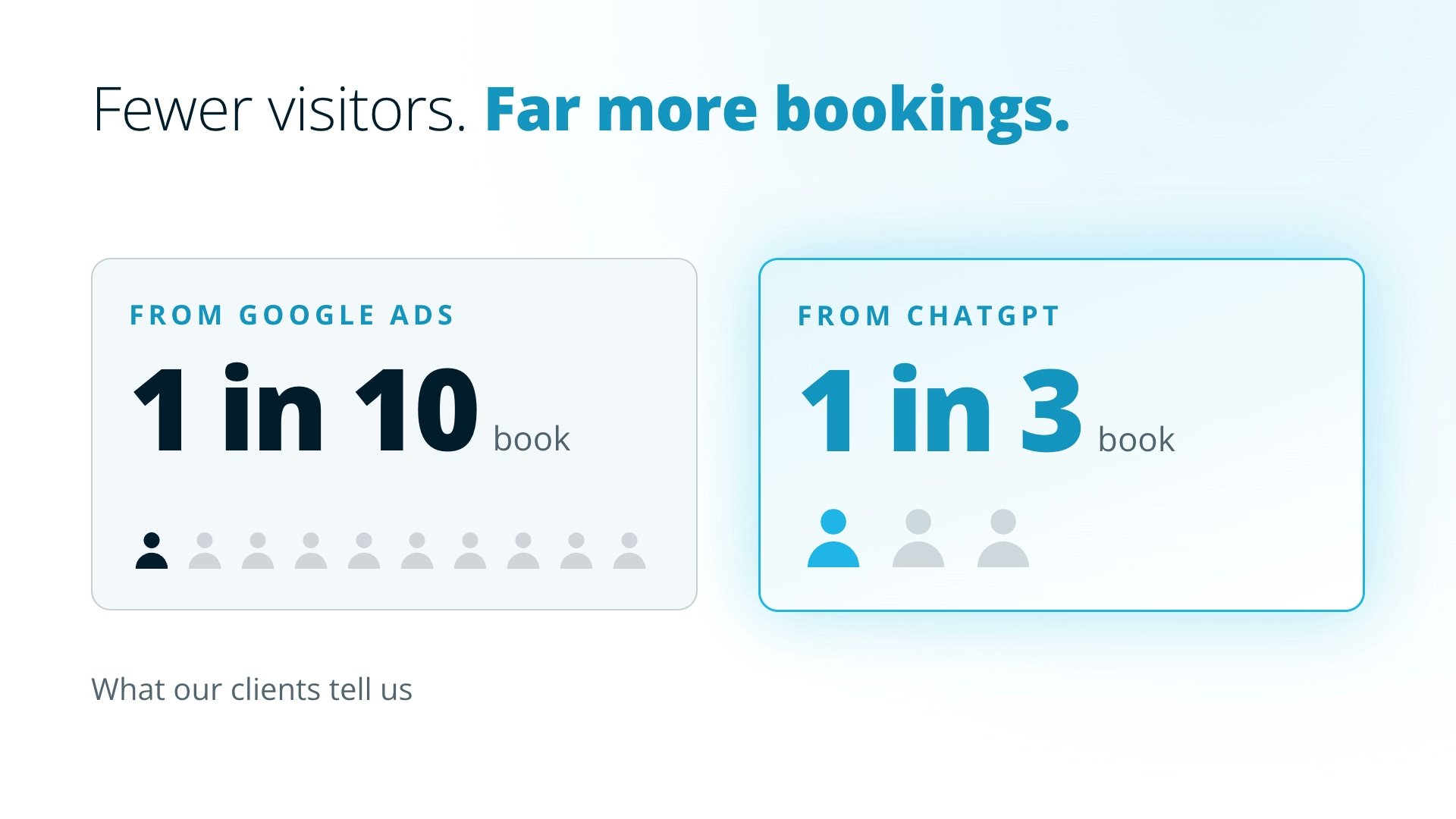
They’ve already spent ten minutes with ChatGPT learning about their problem. They’ve been told you’re the one to see. By the time they land on your website they’re ready to book, and you didn’t pay for that click.
Step 8: The brain
This is where most people get it wrong, because they go straight to AI. “Great, I’ll get ChatGPT to write me fifty pages.”
AI is trained on the whole internet, the best writing and the worst. What it gives you is the average of everything: pages that sound like every other practice. You’ve just built another magazine.
What makes your website the encyclopedia is you. What you’ve forgotten about your work, most people will never know.
So when we build a website, we interview the practitioner for one to three hours. We pull out how you treat, who you help best, what patients worry about and what makes you different. That becomes what we call the brain, and every page is written from it, in your words.
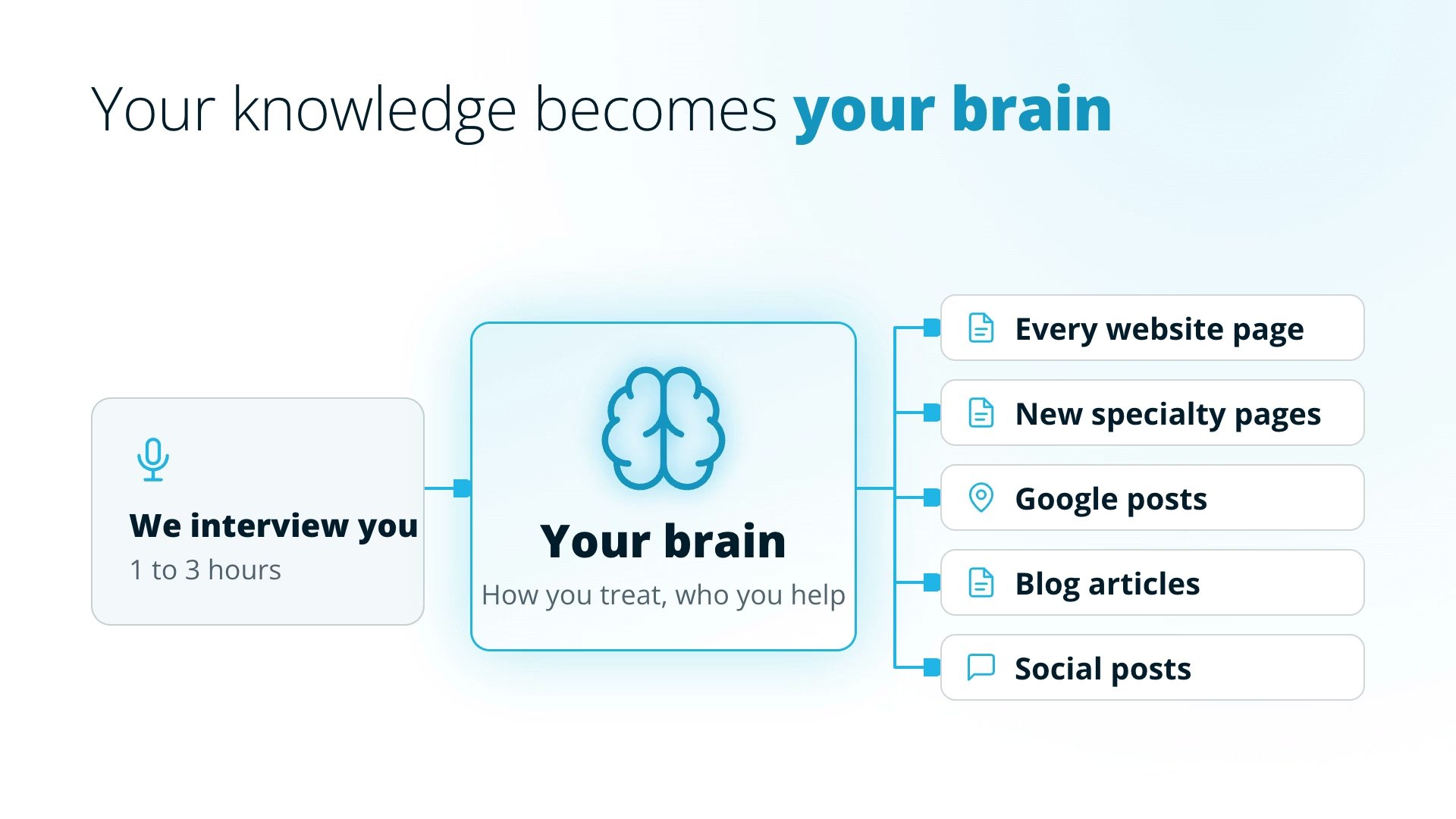
That’s the experience and expertise Google says it wants, and it’s what makes ChatGPT pick you over the practice that copied its website from everyone else. Everyone wants a cheat code. This is the long way round, and that’s why it works.
You can start today. Pick one service. Record yourself on your phone explaining it to a new patient as if they’re sitting in front of you. That recording is your first page.
The phone call
Picture a chiropractor who builds their website this way. One page for every problem they solve, written from what they actually know: desk workers with lower back pain, new mums, runners.
Then the phone rings, and the new patient says: “ChatGPT recommended you. It said you work with people who sit at a desk all day, and that you explain everything before you treat. That’s why I’m calling.”
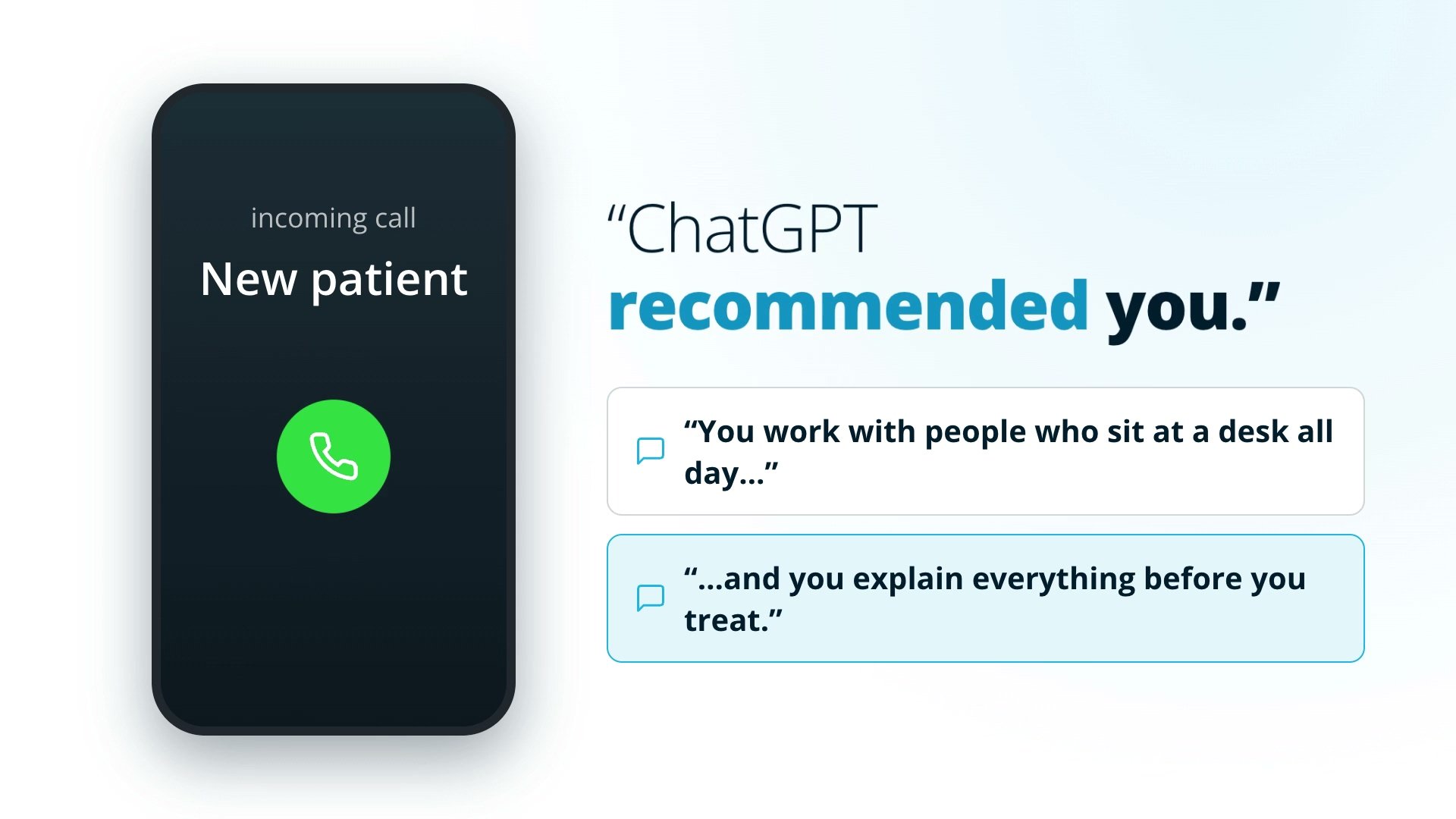
ChatGPT read the website, understood what made that chiropractor different, and repeated it in the chiropractor’s own words before the patient picked up the phone.
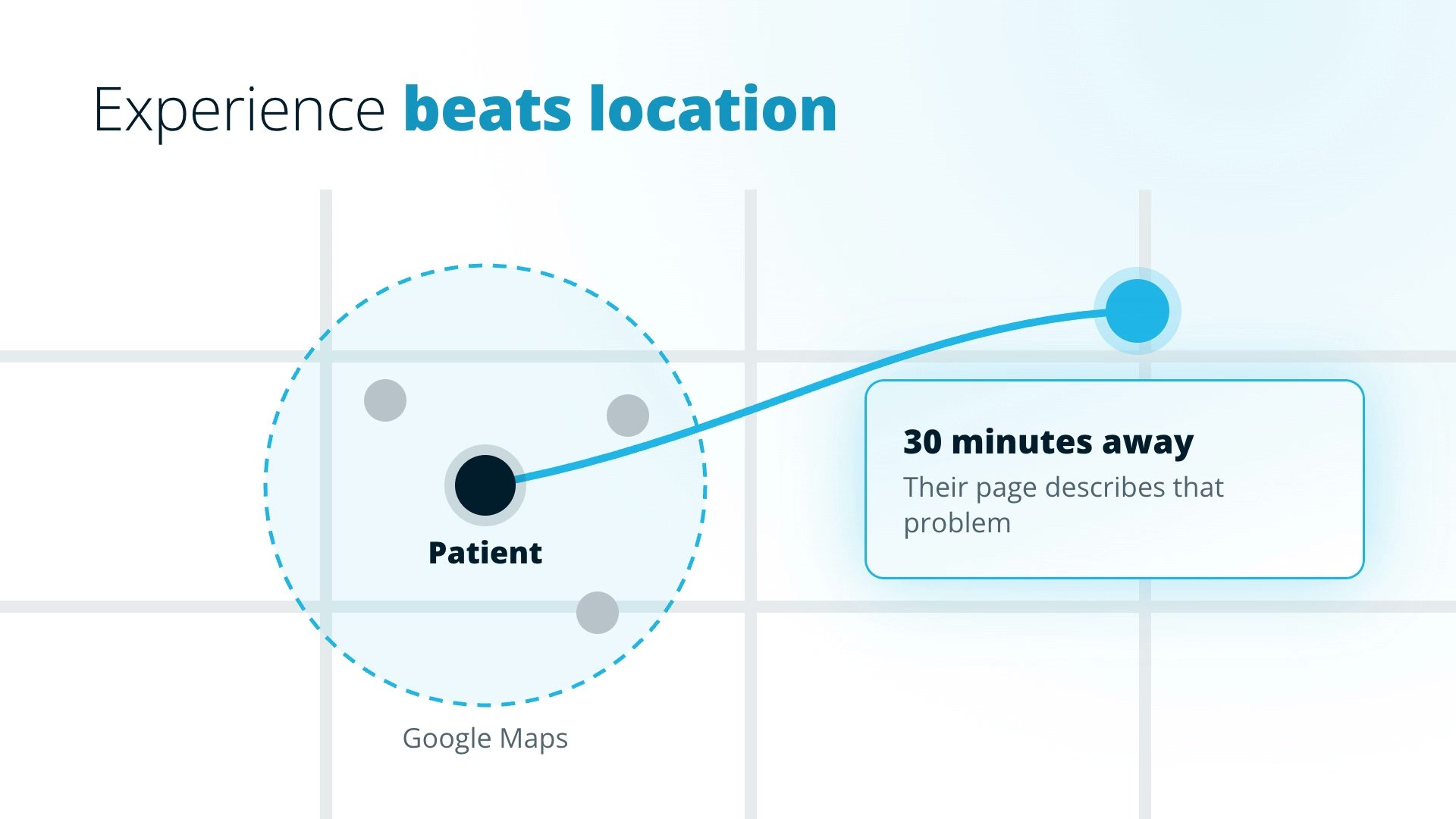
It works even when you’re not the closest practice. Someone tells ChatGPT their whole story, and it finds a practitioner half an hour away, further than Google Maps would ever show them, because that practitioner’s page describes exactly their problem.
The eight steps, quickly
- Patients ask the full story question.
- ChatGPT and Google look for the local encyclopedia.
- It’s built from the six-page answer: service, condition, who it’s for, location, practitioner and how to pay.
- You only have to beat ten or fifteen practices.
- If you’re on top now, you’re probably on top by default.
- The window is open right now.
- The patients ChatGPT sends book about one in three.
- You build it from your brain, not from the internet.
Knowing isn’t doing. If you want to know how far your website is from being the encyclopedia in your area, book the call below. And if you want to see what happens when a practice skips all this, watch the one on the chiropractor paying close to $30,000 a year for marketing and getting zero new patients.
Questions practice owners ask
How does ChatGPT decide which practice to recommend?
It does research. It reads the websites of the practices in your area, learns from the one with the most complete answer, and recommends the practice it learned from. If nobody has the complete answer, it pieces one together from bits of different sites and nobody stands out.
How many pages does my website need for ChatGPT to recommend me?
There's no magic number. For every question a patient asks, you want six pages that answer it: the service, the condition, who it's for, the location, the practitioner and how to pay. A practice with ten pages in total usually can't cover that.
ChatGPT already recommends my practice. Do I need to do anything?
If your site has about ten pages, you're probably on top because everyone around you is just as thin. When one of the other ten or fifteen practices builds a complete website, ChatGPT will start recommending them instead.
Can I use ChatGPT to write my website pages?
On its own it gives you the average of everything on the internet, so your pages sound like every other practice. Record yourself explaining each service to a new patient and build the page from that, in your words.
Do patients from ChatGPT actually book?
Our clients tell us about one in three people who come from ChatGPT book, against about one in ten from Google Ads. By the time they reach your website they've already learned about their problem and been told you're the one to see.
Ready to find your missing patients?
Book your free New Patient Growth Call
45 minutes on Zoom. Before the call I go through your website and your Google profile. On the call I show you the pages you're missing and how many searches each one could bring in. You keep the plan whether you work with us or not.
Book your Growth CallNot ready for a call?
Watch how it works first
A short video on why practices with no SEO retainer are getting more new patients from Google and ChatGPT.
Watch the video